Review of Interventions for Burnout in the Oncology Workforce: A Call for Calming Minds


Samuel Ramjattan, MPH
Doctor of Health Care Administration (DHA) Student
Oklahoma State University Center for Health Sciences (OSU-CHS)


Delaration of Interests: author declared no conflict of interest associated with the publication of this article.
Funding: No funding was received in support of this work.
Correspondence: samuel.ramjattan@okstate.edu


Abstract

Burnout, a persistent state of intense physical, emotional, and mental fatigue, is a significant problem among oncology workers. Oncology nurses have expressed a perception that burnout and stress negatively impact patient care. Given the global mental health crisis, it is important that hospital administrators address the physical and mental well-being of their staff as a public health matter, to contain spillover effects on their patients.

A review of past literature on the topic of burnout among oncology workers and various interventions utilized to combat burnout was conducted with the aim of identifying effective interventions for proactive implementation by hospital administrators. Twelve scholarly articles were reviewed and organized into a literature review table. The findings suggest that a combination of interventions, including mindfulness meditation programs, a supportive work environment, workshops, structured group sessions, and art therapy, is effective at addressing burnout and stress among the oncology workforces.

Based on these findings, novel institutional interventions tailored to the oncology workforce are recommended for implementation. These interventions include decompression rooms, training team leads to conduct guided meditation sessions, and providing tailored workshops to staff based on the issues that are most relevant to them. These interventions can aid hospital administrators in improving the overall well-being of their staff, thereby supporting the delivery of high-quality care to their patients.

Introduction

Burnout is a serious issue among health care workers,1 and oncology workers are particularly vulnerable due to the emotional weight of their work.2 Despite professional boundaries, human emotion is a significant component of compassionate patient care.2 Consistent exposure to sadness, pain, and the death of other human beings can take a toll on the mental and emotional state of workers.2 An oncology nursing population in a study by Russell3 reported that their perceived burnout had a negative impact on patient care3 which is logically likely to affect the patient’s psychological state.

Burnout is defined as a psychological syndrome that affects the physical body, mind, and emotions of an individual, as a result of chronic stress that depletes the ability of the individual to cope.8 Symptoms of burnout include a sense of depersonalization, emotional exhaustion, and a diminished sense of personal accomplishment.1

While it is clear that burnout is prevalent among healthcare workers1 it is unclear why it persists despite past research on the topic.13 This review aims to ascertain which methods are most effective at addressing stress and burnout among oncology workers to guide healthcare administrators in spearheading novel initiatives at their facility to improve the well-being of their oncology staff. This review also aims to identify effective methods to overcome barriers to implementation.

Past peer-reviewed literature on burnout prevalence and interventions among oncology workers will be examined. This review also aims to identify gaps in past literature and methods to overcome past limitations and expected barriers to the implementation of effective burnout interventions.

Extent of the Issue

Healthcare workers are an integral component of our public health infrastructure. A meta-analysis by Yates4 found that 32% of oncology workers were emotionally exhausted, 24% experienced depersonalization, and only 37% felt personally accomplished.4 These statistics indicate a substantial burden on health care workers. Exhaustion can lead to medical errors, and depersonalization is a serious mental health issue that can affect job performance and personal well-being.

In addition to improving overall well-being, addressing the problem of burnout among oncology workers may improve patient satisfaction and outcomes.3 Family members may feel more uneasy if their loved one is being treated by a worker showing signs of burnout. Seriously addressing the issue of burnout among oncology workers can bring significant and widespread benefits for both patients and staff.

Significance of the Study

The purpose of this review is to identify effective methods to combat stress and burnout among oncology workers, with the aim of equipping hospital administrators to take bold action in supporting novel wellness initiatives at their facility. The population of interest includes both inpatient and outpatient oncology workers and patients. A burnt-out workforce can place patients at significant risk.1 Burnout makes employees vulnerable to making medical errors,1 which creates legal risks for medical facilities. Patient satisfaction and attention to detail are crucial in all medical disciplines, including with cancer patients. Therefore, healthcare administrators will also benefit from proactively protecting their workforce from burnout, given the expected meteoric rise in cancer cases as baby boomers age.5 Reviewing past literature to identify successful burnout intervention themes and successful methods to overcome implementation barriers can significantly enhance well-being among the oncology workforce and the quality of care delivered to their patients.

Methods

This literature review aims to identify successful burnout interventions for oncology workers and methods to overcome implementation barriers so that healthcare administrators can proactively and effectively support their workforce. Peer-reviewed articles published within the past ten years were searched for by utilizing the Google Scholar platform. Articles regarding burnout among oncologists, oncology nurses, and general oncology staff were sought. Key words such as "burnout oncology workers," "effect of burnout on patient care," and "effect of meditation programs on burnout in oncology workers" were used to filter articles. A variety of publication forms were considered for inclusion, such as clinical trials, cross-sectional studies, meta-analyses, and reviews.

An initial group of thirteen articles was selected. However, one article was excluded as it was later retracted by the authors. After article selection, a literature review map was created using Microsoft Excel to organize articles by year of publication, type (such as randomized clinical trial, non-randomized clinical trial, cross-sectional study, scoping review, systematic review, or narrative review), and significant or novel findings, as this method has been described as an efficient way to conduct literature reviews.6

The relative statistics and findings of each study were summarized, along with limitations, and any guidance for future research. Articles that did not find a significant link between certain interventions and decreased burnout among oncology workers were also included to reduce selection bias and present a balanced outline of past research.

Studies were reviewed by a thematic analysis method, and findings were organized into themes such as the causes and effects of burnout among oncology workers, the effectiveness of past interventions, and barriers to the implementation of past organizational solutions.

Results

The review search initially identified thirteen articles that met the initial inclusion criteria. However, one article was excluded as it was later retracted by the authors. The remaining twelve articles described the effect of burnout on oncology workers or effective interventions to combat burnout among oncology workers in hospital or clinic settings.

The search resulted in a mix of clinical trials (n=3), meta-analyses (n=2), quantitative descriptive studies (n=1), and reviews (n=6). Of the articles reviewed, the first group examined the prevalence of burnout among the oncology workforce (n=4) while the second group examined the effectiveness of burnout interventions for the oncology workforce (n=8). The findings of these articles were organized into a literature review table (Fig. 1).

Figure 1. Literature Review Table

Article Title Authors Publication Year Publication Type Purpose of the Study Measures Key Findings
Mitigating burnout in an oncological Unit: A scoping review. Alabi, R., Hietanen, P., Elmusrati, M., Youssef, O., Almangush, A., and Mäkitie, A. A. 2021 Scoping Review To identify methods to address and reduce burnout among clinical oncology professionals Interventions (communication skills, well-being and stress management, burnout education, financial independence, relaxation, self-efficacy, hobbies, and work-life balance) and the use of AI to enhance productivity and reduce workload, against burnout among the oncology workforce. The authors reviewed 17 studies and found that a combination of methods was best at reducing burnout among oncology professionals. Some of the methods included stress management, hobbies, and teaching financial skills. The authors also suggest conducting surveys among oncology staff to help tailor workshops to address the most significant issues.7
Burnout and Oncology: an irreparable paradigm or a manageable condition? Prevention strategies to reduce Burnout in Oncology Health Care Professionals Bui, S., Pelosi, A., Mazzaschi, G., Tommasi, C., Rapacchi, E., Camisa, R., Binovi, C., and Leonardi, F. 2021 Journal Article To analyze the effectiveness of 3-hour meetings, held every two weeks, on employee burnout among oncology hospital workers. Interventions (fortnightly meetings covering reflection, shared experiences, and managing emotions) against burnout scores measured by the Maslach Burnout Inventory (MBI), among oncology hospital workers. Burnout is prevalent among oncology hospital workers. Emotional exhaustion, depersonalization, and low rates of accomplishment were attributed to the prevalence of burnout. The researcher's intervention, consisting of sessions addressing work relationships, individual counseling, emotional management, and self-help groups, did not significantly reduce burnout among hospital workers, but did reduce feelings of depersonalization and emotional exhaustion.2
Effectiveness of a mindfulness-based intervention on oncology nurses’ burnout and compassion fatigue symptoms: A non-randomized study. Duarte, J. and Pinto-Gouveia, J. 2016 Non-randomized trial To study the effectiveness of an on-site mindfulness program on burnout, compassion fatigue, and satisfaction with life, among oncology nurses. Interventions (covering mindfulness, self-awareness, communication, interpersonal relationships, teamwork, conflict resolution, emotional management workshops, accepting death, individual counseling, and self-help groups), against burnout among oncology nurses. The data from the study suggest that an on-site mindfulness intervention may be effective in reducing psychological symptoms of burnout and compassion fatigue among oncology nurses, thereby increasing overall wellness. The authors also found reductions in stress and increased life satisfaction after the intervention. The authors further noted that burnout presents a risk of medical errors, increased turnover, and absenteeism. Being single, heavy work demands, and unclear job prospects were identified as risks for burnout.8
Reducing healthcare burnout through meditation: benefits and challenges. Fnu, V., Rajasekaran, D., Pilaniya, A., Aggarwal, K., Virmani, M., Gupta, A., and Jain, R. 2025 Narrative Review To identify the prevalence and impact of burnout among health care workers and review the effect of meditation programs on burnout An intervention (meditation) against burnout and stress among healthcare workers. This review found lower levels of stress, anxiety, burnout, blood pressure, and inflammation among healthcare workers who practice meditation. The authors also noted changes in brain areas associated with memory and emotional regulation, improved mood, and increased energy among healthcare workers who practiced meditation. The authors identified increased turnover, medical errors, staffing shortages, and reduced interest in the healthcare field as risks of burnout. Inadequate or depleted coping mechanisms were identified as risk factors for burnout.1
Oncology staff: burnout, job satisfaction, and coping with stress Guveli, H., Anuk, D., Oflaz, S., Guveli, M. E., Yildirim, N. K., Ozkan, M., and Ozkan, S. 2015 Journal article To evaluate the relationship between burnout, job satisfaction, and stress management with sociodemographic and occupational characteristics among oncology workers. The prevalence of burnout among oncology staff. The study found high levels of emotional fatigue and low levels of job satisfaction among oncology workers. Emotional exhaustion was ten times higher among workers who reported that job-related stress was their most significant source of stress. Maladaptive coping mechanisms were associated with exhaustion, emphasizing the importance of strong coping mechanisms in preventing burnout. The authors recommended monitoring the psychological state of oncology workers and assisting them with developing better coping strategies.9
Efficacy of transcendental meditation to reduce stress among healthcare workers. Joshi, S., Wong, A. I., Brucker, A., Ardito, T. A., Chow, S., Vaishnavi, S., and Lee, P. J. 2022 Randomized clinical trial To identify changes in stress among health care workers in response to a transcendental (mantra-based) meditation program An intervention (transcendental meditation) against stress and burnout among healthcare workers. The study found that a transcendental meditation program significantly reduced secondary outcomes of burnout (such as insomnia and anxiety), in comparison to the control group, but did not significantly reduce primary stress outcomes. The authors suggest that transcendental meditation could be an effective way to combat chronic stress among healthcare workers.10
Perceptions of burnout, its prevention, and its effect on patient care as described by oncology nurses in the hospital setting. Russel, K 2016 Quantitative descriptive study To identify the perception of burnout among oncology nurses, how they perceived that burnout impacted patient care, and possible solutions to burnout. The prevalence and perceptions of burnout among oncology nurses. The authors found a significant level of burnout reported by oncology nurses, who believed that burnout created a significant and negative impact on patient care. High patient-to-staff ratios and skipped or shortened breaks were identified by nurses as possible causes of burnout. Oncology nurses suggested that teamwork, social support, and adequate resources could prevent burnout.3
Coping strategies to prevent or reduce stress and burnout among oncology physicians: a systematic review Schmitz, A., Da Rosa Witeck, C., De Oliveira, J. M. D., Clemons, M., Paiva, C. E., Porporatti, A. L., De Luca Canto, G., and Grossman, S. 2022 Systematic Review To identify the interventions that prevent or reduce stress and burnout among oncologists. Interventions (mindfulness, experience sharing, meetings outside of work, art therapy, stress management strategies, and group sessions) against burnout among oncology physicians. The authors found no significant reduction in burnout after a mindfulness-based education course or communication skills training, but did find improvements in stress levels among oncology staff. Furthermore, experience sharing between oncologists in virtual groups, meetings outside of work, art therapy, and group sessions supervised by counselors were effective in reducing stress and burnout.11
The Impact of Psychological Interventions with Elements of Mindfulness on Burnout and Well-Being in Healthcare Professionals: A Systematic Review. Selič-Zupančič, P., Klemenc-Ketiš, Z., & Tement, S. O. 2023 Systematic Review To evaluate the effectiveness of psychological interventions on oncology professionals An intervention (mindfulness-based training program) against burnout among oncology professionals. The authors found that a mindfulness-based intervention was effective at improving well-being and reducing burnout among oncology staff. Both in-person and online interventions were found to be effective. The authors attributed burnout to excessive workloads and frequent protocol changes.12
Burnout in cancer professionals: a systematic review and meta-analysis Trufelli, D., Bensi, C., Garcia, J., Narahara, J., Abrão, M., Diniz, R., Da Costa Miranda, V., Soares, H., & Del Giglio, 2008 Systematic Review and Meta-Analysis To conduct a systematic review and meta-analysis of past studies on the prevalence of burnout among oncology professionals The prevalence of burnout among oncology professionals. The authors found an emotional exhaustion rate of 36%, a depersonalization rate of 34%, and a personal accomplishment rate of only 25% among oncology professionals. The authors noted that burnout was prevalent globally among the oncology workforce but varied considerably and attributed its prevalence to heavy workloads and limited institutional support.13
Mindfulness as an antidote to burnout for nursing and support staff in an oncological intensive care unit. Urso, C., Laserna, A., Feng, L., Agnite, A., Jawe, N., Magoun, C., Layton, L. S., Nates, J. L., and Gutierrez, C. 2022 Clinical trial The authors sought to implement a mindfulness-based intervention to reduce burnout, stress, anxiety, and depression among ICU oncology staff. An intervention (mindfulness practice) against burnout, stress, anxiety, and depression among oncology support staff . The authors found that their mindfulness-based intervention (which consisted of an 8-week personalized yoga program) increased personal efficacy, but did not significantly influence the rates of anxiety, stress, burnout, or depression, compared to the control group.14
Burnout in oncologists and associated factors: A systematic literature review and meta-analysis Yates, M. and Samuel, V. 2019 Meta-Analysis To explore the prevalence of burnout and its associated factors among oncologists. The prevalence of burnout (measured with the Maslach Burnout Inventory (MBI) tool) among oncologists. The authors found that burnout is prevalent among oncologists. By utilizing the Maslach Burnout Inventory (MBI), the authors found an emotional exhaustion rate of 32%, a depersonalization rate of 24%, and a personal accomplishment rate of only 37%. Risk factors include being single, being younger, the presence of workplace stress, workplace demands, difficulty outside of work, and psychological well-being. The authors noted that burnout can affect patient safety.4


Causes of Burnout

Of the four studies investigating the prevalence of burnout among oncology workers, work stress was attributed as a cause by two studies (Yates and Samuel and Guveli et al),4,9 excessive workloads by two studies (Selič-Zupančič et al and Trufelli et al),12,13 while maladaptive coping strategies, high patient-to-staff ratios, skipped or shortened breaks,3 being single,4 being younger,4 and difficulties outside of work4 appeared once. Of the eight studies that considered interventions to combat burnout among oncology workers, work stress,8 being single,8 and maladaptive coping strategies1 were mentioned as causes once each. In total, of the twelve articles reviewed, work stress or heavy workloads were mentioned in five articles,4,8,9,12,13 being single in two articles,4,8 and maladaptive coping strategies in one article.1

Interventions

Of the eight studies investigating interventions against burnout among healthcare or oncology workers, mindfulness or meditation practices were consistent across six studies.1,8,10,11,12,14 However, Schmitz et al11 and Urso et al14 found mixed results for mindfulness or meditation program,11,14 while the strength of this intervention was echoed across four studies by Duarte and Punto-Gouveia,8 Fnu et al,1 Joshi et al,10 and Selič-Zupanči et al.12 Teaching stress or general coping skills were identified in two interventional studies,1,7 group sessions in two studies,2,11 and communication in two studies.7,8 Individual counseling was mentioned in one study by Duarte and Pinto-Gouveia,8 and the use of artificial intelligence (AI) to reduce workloads and enhance productivity was mentioned by one study conducted by Alabi et al.7

Effective Interventions Recommended to Combat Burnout Among Oncology Workers

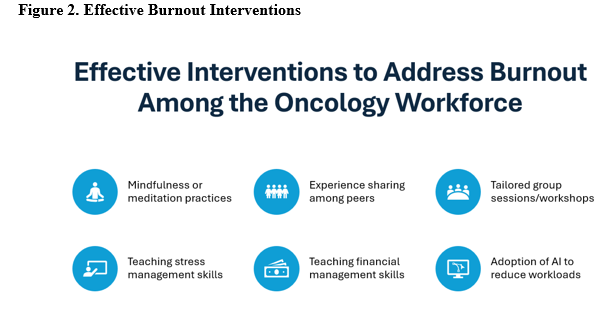
The eight interventional studies reviewed found several effective methods to address burnout among the oncology workforce. Meditation or mindfulness practices were found to be effective in reducing psychological symptoms of burnout and compassion fatigue,8,12 lowering blood pressure, stress, and anxiety,1 reducing insomnia,10 and increasing personal efficacy.14 Additional interventions that were effective at reducing stress and burnout include experience sharing, art therapy, group sessions, and meetings outside of work.11 Additionally, teaching stress management skills, financial skills, hobby adoption, and tailoring interventions to staff needs were found to be effective at reducing burnout among oncology staff.1 Furthermore, Artificial Intelligence (AI) is an emerging technology that could be adopted to reduce workloads and increase productivity.7

Based on these findings, a combination of interventions seems to be the most effective way to address burnout and stress among the oncology workforce. The effective interventions were visually organized in Figure 2.


Limitations of Past Studies

Previous studies by Bui et al,2 Urso et al,14 and Fnu et al1 cited a lack of organizational support and busy hospital environments as a significant limitation. Patient care takes precedence at a medical facility, which can make it challenging to prioritize employee participation in wellness programs. Because burnout is a cause for turnover,1,8 obtaining a consistent workforce sample is a challenge for interventional studies. However, this challenge may be overcome with bold advocacy from healthcare administrators to proactively implement effective wellness interventions tailored to oncology staff. Support from hospital administrators could help secure the resources required to obtain a large sample size that is representative of the oncology workforce.1

Discussion

Burnout, a persistent state of emotional, physical, and mental exhaustion, is an important issue to be addressed by hospital administrators.1 Oncology workers are particularly vulnerable to stress and burnout due to the emotional weight of their work.2 Untreated burnout can result in increased turnover and medical errors,1,8 which can affect the quality of care delivered to patients5 and place medical facilities at increased risk of legal repercussions.

This review organized twelve scholarly articles addressing stress and burnout among oncology workers into a literature review table (Fig. 1) to identify effective interventions to support the oncology workforce with burnout recovery. Four articles explored the prevalence and causes of burnout, while eight articles examined interventional responses to burnout among the oncology workforces.

The literature review revealed that burnout is significantly present among the oncology workforce,4,3,9,13 and the prevalence of burnout is attributed to high patient-to-staff ratios,3 skipped or shortened breaks,3 maladaptive coping mechanisms,9 workplace stress4,8,9,12,13, being single4, and being younger.4 Interventional studies echoed the value of mindfulness or meditation practices to combat burnout, stress, and the accompanying psychological symptoms among oncology workers.1,8,10 Mindfulness or meditation could rectify missed breaks, cited by Russell3 as a perceived cause of burnout among oncology nurses. Mindfulness or meditation practices may also help prevent personal stressors from compounding with work stressors, as difficulties outside of work were cited by Yates and Samuel4 as a cause for burnout. Additional effective interventions include group sessions or workshops tailored to employee needs, such as stress management, hobby adoption, or financial skills.7 Experience sharing, art therapy, and meetings outside of work were also found to be effective.11 The adoption of Artificial Intelligence (AI) was mentioned in one study by Alabi et al7 as a way to reduce workloads and boost productivity. This method could help address one of the root causes of burnout among oncology workers, with workloads, high patient-to-staff ratios, or job-related stress being cited in all four prevalence studies.3,4,9

Key Takeaways

Taken together, these findings suggest that burnout is significantly prevalent among the oncology workforce and presents risks for patient safety due to an increased risk of medical errors.1,8 Healthcare professionals have a duty to take care of others, but should not have their own well-being overlooked. The field of oncology carries considerable emotional weight, as professionals face repeated exposure to patients who are emotionally distressed from cancer diagnoses and others who are undergoing end-of-life care. Given the global mental health crisis, it is important for hospital administrators to proactively combat stress and burnout among the oncology workforce, to prevent effective and compassionate professionals from leaving the field.

Past literature suggests that a combination of interventions is the best way to combat stress and burnout among the oncology workforce. For individual oncology workers, starting meditation practice could lower levels of stress,8,11 reduce feelings of anxiety,8 alleviate insomnia,10 and increase personal efficacy.10 However, busy schedules and heavy commitments can make it difficult for individuals who are already experiencing chronic stress or burnout to practice self-care. Fostering a supportive work environment and teaching healthy coping mechanisms was recommended by Schmitz et al.11 Therefore, organizational interventions may be more effective at combating burnout among the oncology workforce.1,7,11 In order to effectively implement a mindfulness program at a hospital facility, administrators should consider training team leads as meditation coaches and incorporating meditation sessions into mandatory team huddles or meetings, as this approach could overcome the challenges presented by busy hospital environments and a lack of organizational support identified by Bui et al,2 Urso et al,14 and Fnu et al.1 Additionally, as past studies mentioned emotional exhaustion7 and workplace stress,4 it is suggested that healthcare administrators establish spaces specifically for staff to decompress after emotionally stressful situations. These spaces should be designated only as ‘decompression rooms’ with soft lighting, calming scents like lavender, a desk fountain, and comfortable seating, which will allow oncology staff to unwind from stressful situations more deeply than a traditional breakroom will allow. A study by Kennedy Oehlert et al15 reported that ‘tranquility rooms’ were tested as a space to allow overwhelmed staff members to quiet their minds during the COVID-19 pandemic. However, these spaces returned to breakrooms after the pandemic.15 It is proposed that hospital administrators make decompression rooms a permanent fixture on oncology units to promote staff well-being and reduce the risk of stress and burnout.

Healthy coping strategies are not typically covered in the curriculum of public schools. Addressing this problem among the oncology workforce can ignite a cultural shift that improves the mental well-being of our society. Furthermore, past studies have not investigated the resulting impact of burnout interventions on patient satisfaction, which is an area for future researchers to address.

Conclusion

This review of the literature on interventions addressing burnout among the oncology workforce discovered that meditation, stress management skills, financial management skills, experience sharing, group sessions, and fostering a supportive work environment are effective ways to improve the well-being of the oncology workforce.7,8,11 The outline of past literature suggests that healthcare administrators should boldly and proactively support wellness interventions for staff members, as a combination of methods tailored to oncology staff is the most effective way to combat burnout in this population.7 It is recommended that hospital administrators support training team leads as meditation coaches, establish designated decompression rooms (separate from traditional breakrooms) within oncology units, and incorporate burnout interventions into team huddles.


References

1. Fnu V, Rajasekaran D, Pilaniya A, et al. Reducing healthcare burnout through meditation: benefits and challenges. Cogent Ment Health. 2025;4(1):1-18. doi:10.1080/28324765.2025.2477699

2. Bui S, Pelosi A, Mazzaschi G, et al. Burnout and oncology: an irreparable paradigm or a manageable condition? Prevention strategies to reduce burnout in oncology health care professionals. Acta Biomed. 2021;92(3):e2021251. doi:10.23750/abm.v92i3.9738

3. Russell K. Perceptions of burnout, its prevention, and its effect on patient care as described by oncology nurses in the hospital setting. Oncol Nurs Forum. 2016;43(1):103-109. doi:10.1188/16.ONF.103-109

4. Yates M, Samuel V. Burnout in oncologists and associated factors: a systematic literature review and meta-analysis. Eur J Cancer Care (Engl). 2019;28(3):e13094. doi:10.1111/ecc.13094

5. White MC, Holman DM, Boehm JE, Peipins LA, Grossman M, Henley SJ. Age and Cancer Risk. American Journal of Preventive Medicine. 2014;46(3):S7-S15. doi:10.1016/j.amepre.2013.10.029

6. Godino L. How to structure Microsoft Excel documents for systematic reviews. Nurse Researcher. 2023;31(1):40-46. doi:10.7748/nr.2023.e1866

7. Alabi RO, Hietanen P, Elmusrati M, et al. Mitigating burnout in an oncological unit: a scoping review. Front Public Health. 2021;9:677915. doi:10.3389/fpubh.2021.677915

8. Duarte J, Pinto-Gouveia J. Effectiveness of a mindfulness-based intervention on oncology nurses’ burnout and compassion fatigue symptoms: a non-randomized study. Int J Nurs Stud. 2016;64:98-107. doi:10.1016/j.ijnurstu.2016.10.002

9. Guveli H, Anuk D, Oflaz S, et al. Oncology staff: burnout, job satisfaction, and coping with stress. Psychooncology. 2015;24(8):926-931. doi:10.1002/pon.3743

10. Joshi SP, Wong AI, Brucker A, et al. Efficacy of transcendental meditation to reduce stress among health care workers. JAMA Netw Open. 2022;5(9):e2231917. doi:10.1001/jamanetworkopen.2022.31917

11. Schmitz AC, Da Rosa Witeck C, De Oliveira JMD, et al. Coping strategies to prevent or reduce stress and burnout among oncology physicians: a systematic review. Braz J Oncol. 2022;18:CP. doi:10.5935/2526-8732.20220320

12. Selič-Zupančič P, Klemenc-Ketiš Z, Tement SO. The Impact of Psychological Interventions with Elements of Mindfulness on Burnout and Well-Being in Healthcare Professionals: A Systematic Review. Taylor & Francis. Published online June 29, 2023. https://www.tandfonline.com/doi/full/10.2147/JMDH.S398552#d1e942

13. Trufelli DC, Bensi CG, Garcia JB, et al. Burnout in cancer professionals: a systematic review and meta-analysis. European Journal of Cancer Care. 2008;17(6):524-531. doi:10.1111/j.1365-2354.2008.00927.x

14. Urso C, Laserna A, Feng L, et al. Mindfulness as an antidote to burnout for nursing and support staff in an oncological intensive care unit. Holist Nurs Pract. 2022;36(5):E38-E47. doi:10.1097/HNP.0000000000000544

15. Kennedy Oehlert J, Bowen C, Wei H, Leutgens W. Tranquility rooms for team member well-being: Implementation during COVID-19 pandemic. Patient Experience Journal. 2022;9(2). doi:10.35680/2372-0247.1730